

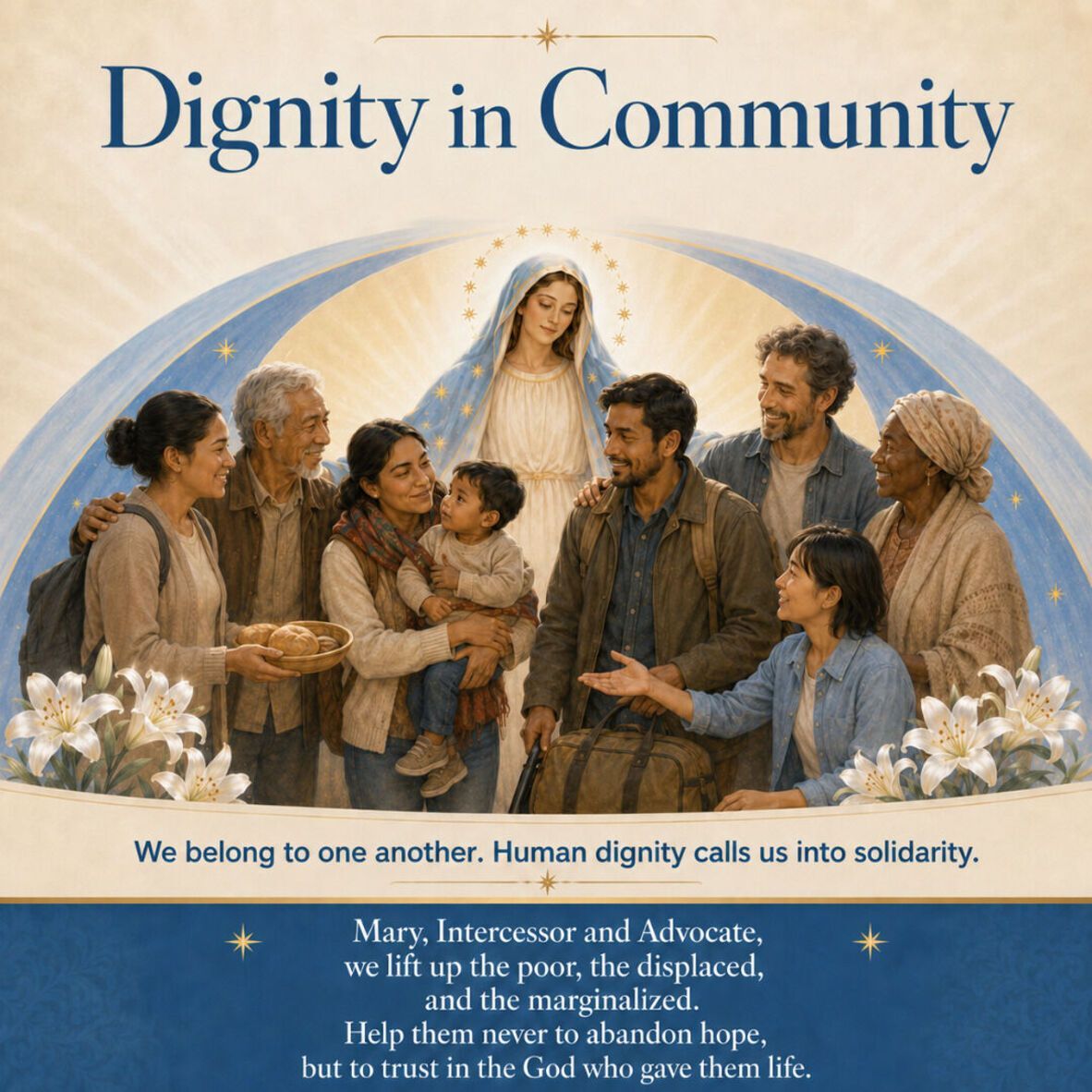
What is Social Dignity and Why Does it Matter? Human Dignity Requires More than Good Intentions. This is the focal point for Week 3 of Respect Life Month 2026. We often think of dignity as something personal. But the Church teaches that dignity also has a social dimension.
Every person possesses an inalienable dignity simply because he or she is created, willed, and loved by God. Yet people can sometimes find themselves living in situations that do not reflect that God-given dignity. Poverty, displacement, isolation, exploitation, and unjust social structures can make it difficult for individuals and families to flourish.
God did not create us to live as isolated individuals. Human beings are made for relationship, family, community, and participation in society. Because every human person possesses dignity, society itself must be organized in ways that respect and promote that dignity. Access to food, shelter, meaningful work, education, healthcare, religious freedom, and participation in community life are not merely political concerns. They are questions of human dignity. The Church's social teaching consistently insists that concern for the vulnerable is not optional. The measure of a society is found in how it treats those who are poor, marginalized, displaced, forgotten, or excluded.
Many Catholics readily recognize threats to human dignity at the beginning and end of life. Social dignity reminds us that human dignity must also be protected throughout life. For this reason, Week Three of Respect Life Month focuses on the realities of poverty and migration. The papal declaration Dignitas Infinita states: “One of the phenomena that contributes significantly to denying the dignity of so many human beings is extreme poverty” (no.36). Likewise, regarding migrants: “Every migrant is a human person who, as such, possesses fundamental, inalienable rights that must be respected by everyone and in every circumstance" (no.40).
These issues challenge us to ask whether our communities, institutions, and social structures help people live in a manner consistent with their God-given dignity. Social dignity invites us to move beyond awareness and toward solidarity. It calls us not only to care about others, but to accompany them, advocate for them, and help build conditions in which all people can flourish. The Catechism of the Catholic Church provides some foundational grounding in relation to immigration:
The more prosperous nations are obliged, to the extent they are able, to welcome the foreigner in search of the security and the means of livelihood which he cannot find in his country of origin. Public authorities should see to it that the natural right is respected that places a guest under the protection of those who receive him.
Political authorities, for the sake of the common good for which they are responsible, may make the exercise of the right to immigrate subject to various juridical conditions, especially with regard to the immigrants' duties toward their country of adoption. Immigrants are obliged to respect with gratitude the material and spiritual heritage of the country that receives them, to obey its laws and to assist in carrying civic burdens.
As recognized by the Church for decades, the current immigration system is inadequate to address the needs of American families, employers, and communities, as well as immigrants themselves. Reforms and investments are needed to modernize/ increase capacity at ports of entry, increase the number of/access to lawful immigration pathways, and establish earned legalization programs for long-time undocumented residents. Let us once again seek the intercession of Our Blessed Mother, that as a country, leadership and the electorate will be courageous in facing this very challenging situation:
Mary, Intercessor and Advocate, We lift up the poor, the displaced, the marginalized and vulnerable members of society; Help them to never abandon hope, but to place their trust in the God who gave them life.
Let His Peace be with you,
Fr. Stephen